Essay clarity
Find thin motivation, generic wording, and claims that are not backed up by the rest of your application.
For 2026-27 dental school applicants
Pre-Dent Guide reviews your essays, experiences, stats, and school list so you can fix weak spots before you pay to apply.
No credit card required for the first review.
What it checks
Find thin motivation, generic wording, and claims that are not backed up by the rest of your application.
See whether your dental exposure, service, employment, research, and leadership read as intentional.
Compare your academic profile, residency, and experience signals against the schools you selected.
Why not just use a Chatbot?
Most AI tools are useful for brainstorming, polishing, or rewriting. That is not the same as reviewing an AADSAS-style application the way an admissions reader experiences it. Pre-Dent Guide evaluates your essay, experiences, achievements, GPA, DAT, residency, and school list together so the feedback reflects the full file, not one isolated paragraph.
What changes when the review is application-first
Instead of handing you one broad response, Pre-Dent Guide checks whether your why-dentistry story is actually supported by the rest of your file, whether your hours and descriptions look credible on the page, whether your school list is balanced, and whether your revisions are resolving the weakness or only sounding cleaner.
Personal statement feedback is judged against the rest of your application, not in isolation.
School-list fit is reviewed through a dental admissions lens, including residency context and profile fit.
Every rerun is saved so you can see whether the application is materially safer to submit.
Generic chatbot
Pre-Dent Guide
Student feedback
The Pre-Dent Guide was incredibly thorough and made the application process feel much clearer. As a pre-dental student, I was able to see exactly which parts of my application needed improvement, and the feedback made my next steps crystal clear. It felt like having an advisor built into the process.
I found Pre-Dent Guide really helpful for identifying weaker areas of my application and understanding how to improve them. It gave me a clear sense of how well my experiences and essays aligned with each school’s mission and focus, which helped me build a more intentional, better-fitting school list.
Pre-Dent Guide helped me craft a much stronger application. The platform gave me detailed feedback on my personal statement and helped identify gaps in my dental-related activities. After implementing its suggestions, I feel extremely confident going into this upcoming cycle.
Pre-Dent Guide gave me valuable feedback across several parts of my application, from improving my manual dexterity descriptions to strengthening my experiences. It’s a great tool for dental school applicants who want to review, refine, and improve their application.
As someone who went through the dental school application process without family in healthcare, I wish I had Pre-Dent Guide earlier. It would have helped me understand my strengths and weaknesses more clearly, identify programs that fit my goals and experiences, and get consultant-level insight at a fraction of the price.
Sample report
This sample report shows the actual evaluation experience: progress tracking, remaining priorities, section-by-section feedback, and the concrete next steps a student would see before revising.
Compressed preview
Preview the dashboard first, then expand to read the priorities, section feedback, school-fit analysis, and evidence checks in full.
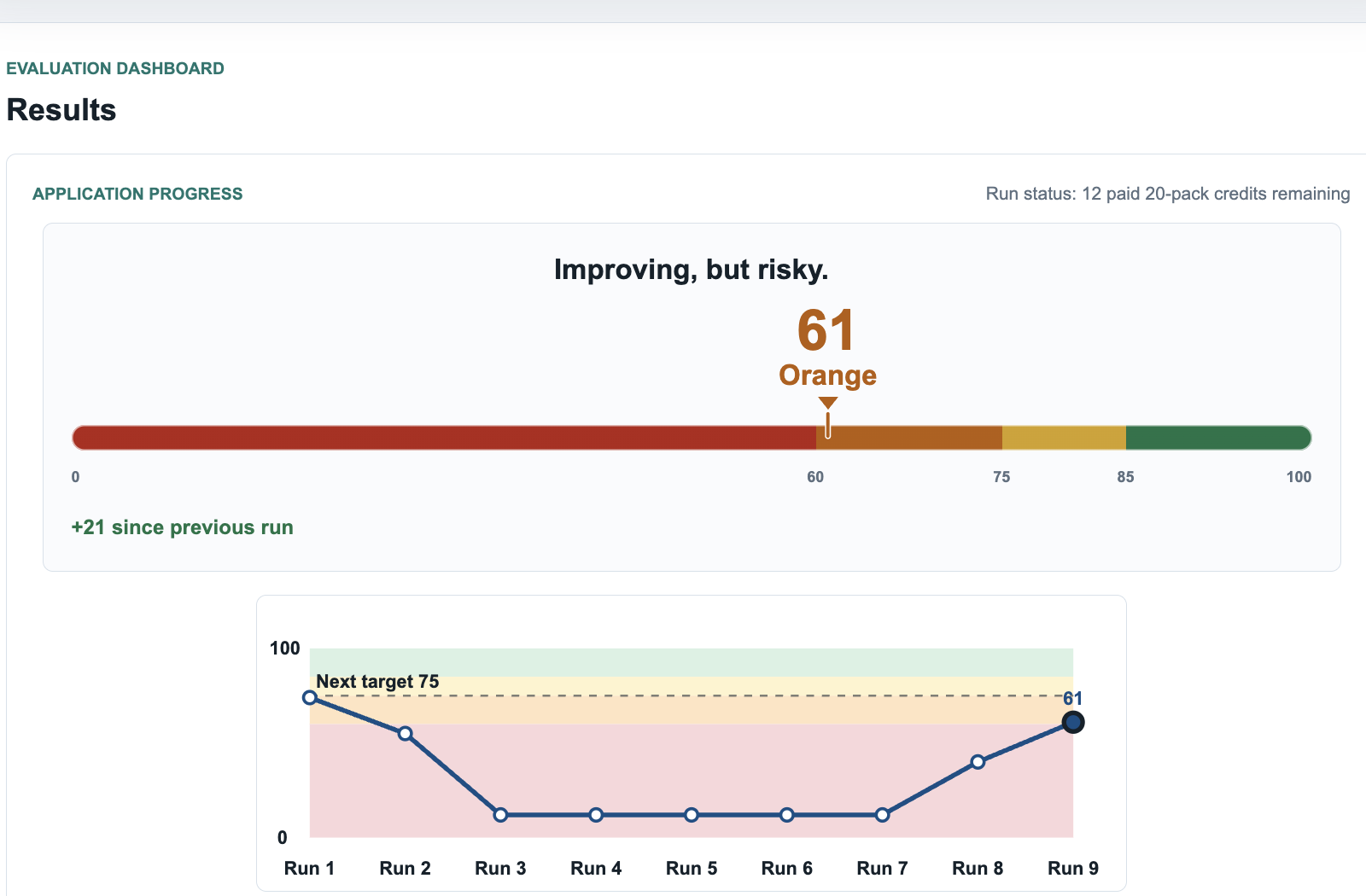
Evaluation dashboard
Application progress
Run status: 12 paid 20-pack credits remaining
Improving, but risky.
+21 since previous run
This applicant presents an exceptionally strong academic profile with a perfect GPA and outstanding DAT scores (AA/TS 500). Their experiences are diverse and impactful, featuring significant leadership, entrepreneurship, and advanced research in data science and AI, complemented by extensive non-dental volunteering. While dental exposure hours meet the minimum benchmark, the descriptions are still brief and the experiences are relatively recent. A critical weakness lies in the personal statement, which, despite strong writing, still fails to articulate a clear 'why dentistry.' The school list is also dangerously thin and includes a highly restrictive out-of-state public institution, posing a major strategic risk.
Best next step
Keep revising on your own with 20 more reviews, or book a Pre-Dent Guide Team consult plus 20 reviews if you want help prioritizing the fixes that matter most.
The consult option is the fastest path if you want a clear plan before the next draft.
Choose your next move
Start with the self-serve pack, or book a Pre-Dent Guide Team consult if you want direct guidance.
Use the same account so your purchase is matched back to your saved application.
1% of what dental admissions consultations charge
Reviewed by
Columbia and Dugoni dental students
Questions? Reach the Pre-Dent Guide Team.
We're always developing new features for the platform, so if there are additions or improvements you'd like to see, do not hesitate to reach out here.
predentguide@gmail.com 347-633-6038Just want the meeting? This button takes you straight to Stripe, then sends you to Calendly so you can book your time right after checkout.
Guardrail check: academic readiness is set to 9/10 from the entered GPA and DAT profile (cumulative GPA 4.00, science GPA 4.00, DAT AA 500, TS 500, PAT 440).
Academic Readiness drop: The Academic Readiness score dropped due to a decrease in reported DAT scores. Previous DAT scores: AA 600, TS 600, PAT 600. Current DAT scores: AA 500, TS 500, PAT 440.
Guardrail check: dental experience is set to 8/10 from the entered exposure totals: 300 combined dental hours, general dentist exposure present, specialist exposure present.
Guardrail check: experiences are set to 5/10 from the current experience evidence, including 670 non-dental volunteer hours and 13 entered experiences.
Despite strong writing and compelling anecdotes, the personal statement still does not answer why dentistry in a specific, reflective way or fully connect the applicant's background to a sustained dental commitment.
Guardrail check: manual dexterity is set to 6/10 from the current hand-skill response and writing-detail cap.
The school list is extremely thin, consisting of only two institutions. One of these, Dental College of Georgia, is a public school with a very restrictive out-of-state enrollment, making it an exceptionally difficult target for an out-of-state applicant.
The applicant crafts a compelling narrative that traces their journey from a tech entrepreneur and data scientist to a dedicated dental school candidate. The essay uses a unique project, TrypSync, as a framing device to explore a desire to blend technology with tangible, human-centered impact. However, the central argument still needs a more direct and reflective answer to why dentistry.
Why dentistry: The essay points in the right direction by connecting technological problem-solving, hands-on work, and meaningful human connection, but it still needs a more explicit and dentistry-specific turn.
Hook strength: Strong
Opening: The opening is highly effective. The TrypSync anecdote is unique, memorable, and immediately establishes the applicant as an innovative and proactive problem-solver.
Conclusion: The conclusion is solid but the final line lands a little too generically, which softens an otherwise sophisticated essay.
Strongest moment: The anecdote from the Ben Massell Clinic is the essay's emotional and argumentative core, especially the patient reaction that shows dentistry's power to restore dignity and confidence.
Weakest moment: The transition from the first paragraph into the hands-on hobbies paragraph is the least fluid part of the essay and reads more like a list than a continuous argument.
Revision focus: The next revision should answer why dentistry directly, using specific evidence rather than only describing exposure or general service values.
The personal statement is broadly supported by the extensive experiences listed in the application, especially around technology, service, and real dental exposure. The main gap is not fabrication; it is that the essay still does not clearly state why dentistry in a specific, reflective way.
Alignment: Mixed
Supported claims
No unsupported claims were highlighted.
Mismatches
Strength: Weak
Writing quality: Weak
Writing assessment: The response is extremely brief and generic. It makes a claim about developing finger dexterity and hand-eye coordination but provides no specific details, examples, or elaboration on how playing piano achieved this.
Reviewer note: Piano is a relevant activity and long-term engagement is a useful starting point, but the response needs specific aspects of practice, difficulty, repetition, and precision to be persuasive.
Strongest evidence: The mention of playing piano since age 10 indicates sustained, long-term practice, which is a positive attribute for developing manual skills.
Weakest part: The complete lack of specific examples, challenges, or detailed explanation of how piano playing developed the claimed skills.
An exceptionally strong applicant with a highly impressive and diverse profile, particularly in leadership, entrepreneurship, and advanced data science or AI research. Academic achievements are stellar, and non-dental volunteering is extensive and impactful. Dental exposure meets the minimum benchmark, but it is a more recent addition compared with the applicant's other long-standing and high-level commitments.
Balance read: The profile is heavily weighted towards high-level research, entrepreneurship, and leadership roles, particularly in data science and AI. While these demonstrate exceptional intellectual capacity and drive, the dental exposure appears as a more recent and less dominant theme in an otherwise extraordinary resume.
Achievement signal: The achievements section strongly reinforces the applicant's academic prowess and significant impact in leadership and innovation.
Most impressive
Underdeveloped areas
Strategic strengths
Strategic weaknesses
The applicant presents an exceptionally strong academic profile with a perfect GPA and outstanding DAT scores (AA/TS 500), complemented by significant research experience (858 hours) and extensive non-dental volunteering (670 hours). The current school list, however, is extremely thin with only two schools, one of which is a highly restrictive public institution for out-of-state applicants.
Balance: Thin
Fit strengths
Fit risks
Suggestions
Suggested schools to consider
This school is an excellent fit for the applicant's perfect GPA and extensive research background, aligning with Harvard's focus on academic leadership and research. It is also OOS-friendly.
Academic read: High reach
School emphasis: Harvard's physician-of-the-mouth model is built for applicants who can pair top academics with research-heavy or surgical-specialty ambitions.
Watchout: While the GPA is perfect, the applicant's DAT score of 500 is slightly below Harvard's average of 510, making it a high reach.
Penn's emphasis on high academics, research, and global service aligns well with the applicant's GPA, research hours, and extensive non-dental volunteering. It is also very OOS-friendly.
Academic read: Strong
School emphasis: Penn blends prestige, special-care exposure, and research customization, so it fits applicants who are both academically strong and mission-aware.
Watchout: Make sure the application clearly articulates how research and service experiences connect to Penn's mission and opportunities.
This school is a strong academic fit, and its research-intensive mission is well-matched by the applicant's 858 hours of research. It is also OOS-friendly.
Academic read: Strong
School emphasis: Case Western leans research-intensive and leadership-oriented, with an emphasis on preventive care and strong multicultural communication.
Watchout: Highlight leadership experiences or interest in preventive care to strengthen fit with Case Western's specific priorities.
The applicant's 670 hours of non-dental volunteering strongly align with Loma Linda's mission of service and whole-person care, making it an excellent mission-fit school.
Academic read: Strong
School emphasis: Loma Linda emphasizes compassionate service and whole-person care, so mission fit is strongest when the file clearly shows service-minded values.
Watchout: Make sure the personal statement and experiences clearly articulate service-minded values and how they connect to Loma Linda's mission.
Marquette values service and manual dexterity, both of which are strong points for the applicant. Academically, the applicant is very strong for this school.
Academic read: Strong
School emphasis: Marquette's person-for-others framing and early hand-skills emphasis make it a better fit when service values and manual precision both read clearly.
Watchout: Articulate how manual dexterity from piano translates to dental skills and how service experiences align with Marquette's philosophy.
School-by-school fit
The applicant's perfect GPA and substantial research hours align very well with Columbia's mission, making them a competitive candidate for this highly selective, research-focused institution.
Academic read: Competitive
School emphasis: Columbia is a premier specialty feeder with an integrated medical curriculum and tends to reward applicants with elite academics and a serious research orientation.
Why it could work
What to watch
Action tip: Emphasize the depth and impact of research experiences and connect them directly to Columbia's mission of innovation and specialty matching.
Academically, the applicant is very strong for Augusta, but out-of-state status at a school with extremely limited OOS enrollment presents a significant challenge.
Academic read: Competitive
School emphasis: Augusta emphasizes broad clinical preparation across a statewide footprint and fits applicants who want strong comprehensive care training.
Why it could work
What to watch
Action tip: Unless there are compelling ties to Georgia, replace this school with an institution that has a more favorable out-of-state enrollment profile.
The profile is heavily weighted towards high-level research, entrepreneurship, and leadership roles, particularly in data science and AI. While these demonstrate exceptional intellectual capacity and drive, the dental exposure appears as a more recent and less dominant theme in an otherwise extraordinary resume.
Achievement review: The applicant presents a very strong set of achievements, including highly competitive merit scholarships, national recognition, and awards for entrepreneurship and community service.
Strongest achievement: Emory Oxford Woodruff Scholar
Weakest achievement: Dean's Honors List
Security and privacy
Pre-Dent Guide stores your application data encrypted at rest, uses it to run your review and return your results, and lets you erase the application fields currently saved in your account whenever you want.
Your application data is stored encrypted at rest so saved materials are protected inside the system that powers your account.
You can erase the application fields currently saved in your account whenever you want, directly from inside the product.
Your saved materials are used to run your review and return your results, with the full handling details in the Privacy Policy.
Simple pricing
Use the first review to understand the gap. Keep revising yourself or add a consult when you want the Pre-Dent Guide Team to help prioritize the fixes.
1% of what dental admissions consultations charge
Included
$0
Most flexible
$29 $39
Direct help
$89 $99
Evaluation workspace
Fill out the same core materials admissions readers will see. You can save drafts before signing in, then process the review when the application is ready.
Profile